
Case studies / Associated Case studies / South eastern Australia
Associated Case Study: South Eastern Australia
The following is a short description of policy and research questions of an accosiated case study of POLICYMIX. Associated case studies are conducted by researchers not formally part of the POLICYMIX project, but with a research interest in exchanging guidelines, results and recommendations on the economic instruments for biodiversity conservation and ecosystem service provision. This page will be continually updated as the case study is carried out during 2011-2013.
Author: Dr Stuart Whitten, CSIRO Ecosystem Sciences, stuart.whitten@csiro.au, +61 2 62421683
1. Introduction
2. National/federal level case study
3. State and the local case studies
----------------------------------------
1. Introduction
Australia is one of the 17 megadiverse biodiversity nations. Despite the efforts to manage biodiversity in Australia, biodiversity loss continues. Land and water management and landuse conversion, including urban development, climate change, and invasive species are major threats facing biodiversity in Australia. These same factors have degraded the ecosystem services from many landscapes across Australia.
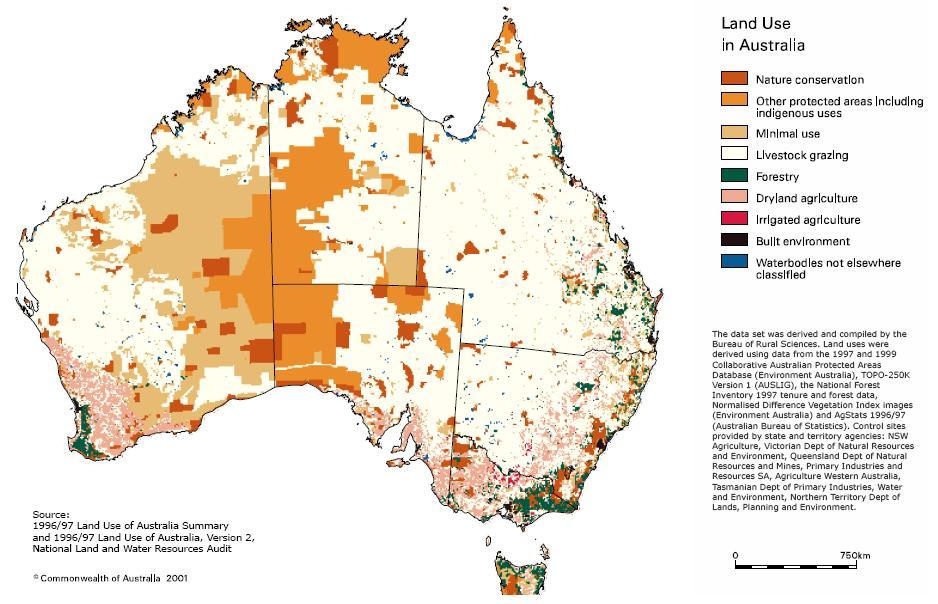
Land use Australia
These same factors have degraded the ecosystem services from many landscapes across Australia. Compared to most temperate climate nations Australia has a relatively low proportion of forests with potential commercial use (2% of total land area) and an even smaller area under private management. In contrast woodlands are primarily privately managed and are critical for biodiversity; including a number of nationally threatened ecosystems (listed under the Australian Government Environment Protection and Biodiversity Conservation (EPBC) Act 1999) such as box gum grassy woodlands, peppermint box woodlands, and weeping myall woodlands. These woodlands are also listed as threatened communities under similar State (province level) legislation. Woodland ecological communities are subject to similar transition processes as forest ecosystems in many countries.
Woodland biodiversity is threatened because they are poorly conserved, highly fragmented, and have largely been cleared and converted to an agricultural landuse matrix where ongoing landuse conversion and degradation threatens biodiversity values. Degradation tends to follow a trajectory starting with grazing by domesticated livestock, proceeding via addition of nutrients and fodder species, and finally replacement of native vegetation by introduced crops and pastures.
A critical issue in the biodiversity and ecosystem service settings under consideration is the need to reconstruct the landscape to provide the basis for functional ecological persistence of biodiversity in the face of ongoing threats. The focus is proposed to be on the policy mix(es) that are able to support landscape reconstruction, downplaying the necessity of being able to measure success in landscape reconstruction (for which other research is ongoing in CSIRO and other organizations in Australia).
2. National/federal level case study
The national level case study is proposed to focus on box gum grassy woodlands and related overlapping or related threatened ecological communities (such as weeping myall woodlands, grey box woodlands, and a range of native grasslands). This community is of interest because of the ecological richness of the community and the ongoing threats to its viability.
Conservation status and objectives
The ecological community formerly covered more than 5 million hectares across the region illustrated in Figure 1 below. It is estimated that less than 5% of this community remains in good condition (www.environment.gov.au/epbc/publications/pubs/box-gum.pdf). There has been significant and ongoing government investment in these grassy woodlands through a variety of different programs and at different levels of government indicating the continuing policy relevance and interest in further policy reform.
The draft recovery objectives for this community which can be extended to most ecological communities in this region (which are also extensively cleared or modified) are 1:
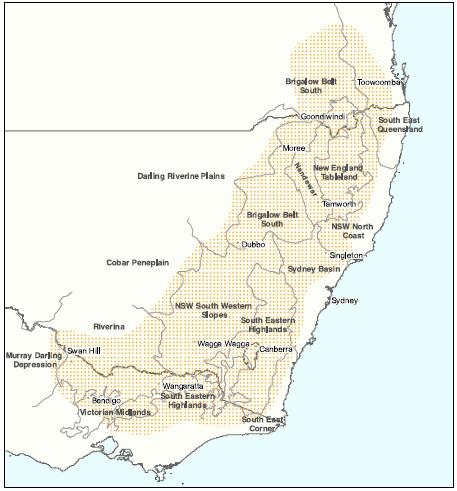
Figure 1: Distribution of box gum grassy woodlands.
- achieving no net loss in extent and condition of the ecological community throughout its geographic distribution;
- increasing protection of sites in good condition;
- increasing landscape functionality of the ecological community through management and restoration of degraded sites;
- increasing transitional areas around remnants and linkages between remnants; and
- bringing about enduring changes in participating land manager attitudes and behaviours towards environmental protection and sustainable land management practices to increase extent, integrity and function of Box-Gum Grassy Woodland..
Recovery to date has focused on reducing loss of the remaining ecosystem inclusive of the ecosystem service benefits that this is likely to provide. Future investment is likely to be increasingly focused on achieving a sound basis for functional ecological persistence of the community in specific landscapes. It is this broad objective that frames this case study.
2.1 Main economic instruments in use in forest/biodiversity conservation and related regulatory instruments
A range of instruments have been applied to the protection and management of grassy woodlands through a mixed set of delivery approaches. The primary responsibility for natural resource management (including biodiversity) lies at the state government level in Australia. Federal government interest in grassy woodland management is primarily driven by identification as an ecological community of national importance.
Regulatory instruments are intended to prevent direct loss of biodiversity through landuse clearing and other direct impacts. At the state level there are vegetation clearing laws which are intended to eliminate broad-scale clearing in each of the states (for example in NSW the Native Vegetation Act 2003). Similar protection is given at the national level for listed communities via the EPBC Act 1999.
A range of other interventions have also been undertaken at the national and state scale as follows including notes on the primary delivery pathway.
Information approaches were prevalent during early phases of intervention and continue to provide important elements today. These include activities such as:
- Information campaigns direct to landholders, via the internet, field days and other delivery paths. These are undertaken by government, quasi-government (CMAs, Land for Wildlife) and not for profit organizations such as Greening Australia;
- Management advice through Catchment Management Authorities which are regional organizations (some statutory and some incorporated) intended to provide a conduit for advice and funding of natural resource management to private landholders; and
- Demonstration projects illustrating options for improved landscape management (these were an important component of the National Landcare initiative in the late 1980s and early 1990s).
Incentive based approaches have become increasingly important through time. Investments are usually a joint program between state and federal governments, however more the more recent focus on grassy woodlands under the Australian Government Environmental Stewardship Program is a stand alone national initiative. Again a variety of approaches and delivery pathways have been used including:
- Various taxation initiatives intended to reduce the cost to landholders of improved natural resource management (with relatively little uptake);
- Cost share grants which required landholders to invest a minimum amount, or proportion of total project costs. These were the favoured investment pathway during the 1990s under a range of government programs. Entry to these programs was partially first come – first served and partly competitive favouring a mix of environmental benefits and reduced costs to government;
- Non-cost share grant programs (similar in operation to previous); and
- Incentive payments through conservation auctions have been introduced most recently through the Australian Government Environmental Stewardship Program.
Other approaches that have also been applied in parallel or in coordination with regulatory, information and incentive approaches include:
- Biodiversity offset programs are in place at the state level and under the EPBC Act 1999 requiring damage to ecological communities to be offset by at least an equivalent improvement in quantity or condition elsewhere;
- Revolving funds are in place in each state providing purchase, covenant, re-sale opportunities;
- Conservation covenants or equivalent legal protection measures are available at the national, state and in some cases the local government level; and
- Not for profit environmental groups are also prevalent but less active in agricultural settings.
An important change to the targeting of investment has occurred more recently through the Australian Government’s Environmental Stewardship program. This program specifically targets management of grassy woodlands for their conservation value and is intended to deliver an improvement in condition and extent of the ecological community. A second feature of the environmental stewardship program is an evolution from investment only within the defined ecological community towards investment in the surrounding agricultural landuse matrix with the objective of improving the condition of the grassy woodland ecosystem. Future investment is likely to target landscape reconstruction with an objective of enhancing functional ecological persistence of grassy woodland meta-communities (see below).
2.2 New instruments under consideration or to be assessed
Governments are moving towards increased use of market based approaches to their investments in conserving and managing ecological services. Two changes to existing approaches are currently being discussed (and are likely to be implemented in some form):
- Landscape approaches to conservation auctions: conservation auctions to date have been assessed on the basis of marginal gain at the paddock scale (i.e. usually modeled improvement in condition of the specified area under contract). An alternate approach is to model the predicted marginal improvement to the probability of persistence of a meta-community or to landscape ecological health. A modified metric for conservation auctions has recently been developed that extends their focus to activities in the agricultural matrix with impacts on the specified grassy woodland site (evaluating the effectiveness of this approach is anticipated in the near future). The revised conservation auction design will also require innovation in implementation to ensure that the ecological benefits from coordinated bids occur (for example through some form of information feedback to landholders or a modified agglomeration bonus).
- Extension of EPBC listing to threatened landscapes (anticipated as a result of recent review): this will assist the integrated investment in meta-populations and meta-communities by encompassing the heterogeneity of vegetation communities found in landscapes and facilitate enhanced consideration of the positive and negative effects of different activities in the landscape with respect to the conservation objective.
3. State and the local case studies
|
There are several opportunities available for state and local case studies of specific instruments or specific attributes of instruments. We propose to negotiate these along with seeking local co-funding if this case study seems like a promising addition to the POLICYMIX project. Three opportunities are described below. |
State-level maps, if applicable: maps of reserve areas and forest cover (with legend) |
State-level maps, if applicable: maps of reserve areas and forest cover (with legend)
See Figure 1 above for distribution of box gum grassy woodlands in south eastern Australia. A map showing reserve areas and recorded presence/absence will be provided if the case study is accepted.
3.1 Introduction
Case studies will be based in sub-regions of the grassy woodland area set out in Figure 1. The likely candidates are at present:
- The Lachlan, Murrumbidgee and Central West Catchment Management Authority regions in NSW. This case would relate to the Environmental Stewardship investments and the implications of changes to that approach (primarily in terms of measuring outcomes and integrating these measures into program design). An extension to this case could focus on the investigation of a landscape oriented conservation auction.
- The Queensland Murray Darling Catchments area in southern Queensland or Wimmera Mallee in Western Victoria. This case would focus on how different approaches can be integrated to deliver a suite of environmental outcomes across an agricultural and conservation matrix with the objective of enhanced ecological function at the landscape scale.
- There are opportunities for different case studies which could focus on transaction costs of alternative approaches.
3.2 Main ecosystem services under evaluation
- Biodiversity (primary, independent of role in ecosystem services)
- Landscape function (salinity prevention, water storage and release)
- Aesthetic.
- There will likely be others to be described.
3.3 Main actors/stakeholders
- Private landholders
- State and federal government (specifically the relevant environmental departments)
- Catchment management authorities
- Researchers
- Not for profit organizations (Greening Australia, Bush Heritage Australia).
3.4 Main economic instruments in use in forest/biodiversity conservation and related regulatory instruments
- Regulatory restrictions intended to prevent clearing of woodlands (and to a lesser extent native grasslands). These include the state level native vegetation laws and the EPBC Act at the national level.
- Information and extension campaigns
- Cost sharing and grant based schemes (primarily competitive)
- Conservation auctions to targeted sub-regions under the Environmental Stewardship program.
3.5 New instruments under consideration or to be assessed
- Change of conservation auctions focus to landscape ecological function (probability of persistence of suite of species within specified ecological community).
- Strategic assessment of an instrument suite targeting multiple market failures across a heterogeneous agricultural and biodiverse landscape.
- Other options may present in the near future due to reviews of government programs.
Based on the types of instruments and ecosystem services of interest in the case study, the following areas have been identified as particularly relevant for local level policy impact assessments in the second local level phase of the case studies.
---------------------------------------------------
1 The Australian Government’s draft national recovery plan can be found at:
www.environment.gov.au/biodiversity/threatened/publications/recovery/pubs/draft-for-comment-bggw.doc
Abebe, S. et al. (2011) A review of the cost-effectiveness and performance of selected Verifiable Emission Reduction (VER) carbon offsets. Joint Technical Brief POLIYCMIX and FUNCiTREE No. 1
Project publications • Ecosystem service values
Andrade, J. et al., compensation for Legal Reserves in Northwest Mato Grosso: a policymix to reduce deforestation
Project publications • Modelling
Balvanera, P. et al.(2012). Ecosystem services research in Latin America: The state of the art . Ecosystem Services, In Press
Peer reviewed • Biodiversity and ecosystem impact;Ecosystem service values;Policy instruments - AEM
Barton et al. (2014) Guidelines for multi-scale policy mix assessments. POLICYMIX Technical Brief No. 12
Project publications • Institutional fit;Policy instruments - Comparisons & mixes
Barton, D. N. et al. (2010) Assessing the Role of Economic Instruments in a Policy Mix for Biodiversity Conservation and Ecosystem Services Provision: A Review of Some Methodological Challenges. Discussion Paper 1-2010
Project publications • Policy instruments - Comparisons & mixes
Barton, D. N. et al. (2012)Assessment of existing and proposed policy instruments for biodiversity conservation in Norway. Report 1/2012
Project publications • Policy instruments - Comparisons & mixes
Barton, D. N. et al. (2013) Guidelines for opportunity cost evaluation of conservation policy instruments. Technical Brief Issue no. 11 (rev.)
Project publications • Ecosystem service values
Barton, D.N. , I. Ring, G. Rusch (2014) Policyscape: Nature-based policy mixes for biodiversity conservation and ecosystem services provision
Project publications • Institutional fit;Policy instruments - Comparisons & mixes
Barton, D.N. et al. (2013) Policyscape—A Spatially Explicit Evaluation of Voluntary Conservation in a Policy Mix for Biodiversity Conservation in Norway. Society & Natural Resources: An International Journal, 26:10, 1185-1201
Peer reviewed • Biodiversity and ecosystem impact;Ecosystem service values;Modelling;Policy instruments - Protected area enforcement;Policy instruments - PES
Begossi, A., May, P. H., Lopes, P. F., Oliveira, L.E.C., Vinha, V. and Silvano, R.A.M. 2011. Compensation for environmental services from artisanal fisheries in SE Brazil: Policy and technical strategies. Ecological Economics, 71:25- 32.
Peer reviewed
Bernasconi, P.; S. Blumentrath; D.N. Barton; G. Rusch & A. R. Romeiro (2013) Policyscape— The potential of Tradable Development Rights (TDR) to improve effectiveness and reduce the costs of biodiversity conservation: study case in Sao Paulo, Brazil.
Project publications • Biodiversity and ecosystem impact;Ecosystem service values;Modelling
Bittner, S. and Lienhoop, N., 2013: Understanding non-participation of farmers in agri-environmental schemes for afforestation. The case of West Saxony.
Project publications • Ecosystem service values
Blumentrath, S. (2011) Site prioritisation models and their suitability for assessing and designing policy mixes for biodiversity conservation and ecosystem services provision: a comparison of software packages. Technical Brief Issue no.4
Project publications • Biodiversity and ecosystem impact;Modelling
Brouwer, R. and Simon, T. (2011) Review of the Biodiversity Valuation Literature and Meta-Analysis. Report 5/2011
Project publications • Ecosystem service values;Modelling
Brouwer, R. et al. (2013) Guidelines for biodiversity valuation and benefits assessment of economic instruments. Tecnical Brief Issue no. 10
Project publications • Ecosystem service values
Brouwer, R., Tesfaye, A., and Pauw, P. (2011). Meta-analysis of institutional-economic factors explaining the environmental performance of payments for watershed services. Environmental Conservation, 38(4), 380-392.
Peer reviewed • Ecosystem service values;Modelling
Bunikyte, R., G. M. Rusch, and B. J. Graae. 2012. A time-line analysis of the public biodiversity conservation mix: Changes in conservation gains in the county of Sør-Trøndelag.
Project publications • Biodiversity and ecosystem impact
Cassola, R.S. 2011. Ecological Fiscal Transfers for Biodiversity Conservation: Options for a federal-state arrangement in Brazil. Master thesis, Albert-Ludwigs-Universität Freiburg, Freiburg im Breisgau.
Project publications • Institutional fit;Modelling;Policy instruments - Ecological fiscal transfers
Chacón-Cascante et al. 2013. Evaluating the policymix path dependency of PES using socio-ecological system characteristics: the case of Hojancha, Nicoya and Nandayure
Project publications • Institutional fit;Policy instruments - PES
Chacón-Cascante et al. 2014. Social Impact evaluation of forest conservation and reforestation PES contracts in Hojancha
Project publications • Social impact;Policy instruments - PES
Chacón-Cascante, A.et al. (2012). Costa Rica: National level assessment of the role of economic instruments in the conservation policymix. Report 2/2012
Project publications • Policy instruments - Comparisons & mixes;Policy instruments - Protected area enforcement;Policy instruments - AEM
Clemente, P., Santos, R., Antunes, P., Pinto, R. Assessing farmers’ perceptions and performance of agri-environmental schemes in a multifunctional agro-forest system: lessons for instrument design in a conservation policymix.
Project publications • Biodiversity and ecosystem impact;Social impact;Policy instruments - Protected area enforcement;Policy instruments - AEM
Cárdenas et al. 2014. Costa Rica: Effectivity of PES carbon balance in livestock systems in Nicoya peninsula, Costa Rica
Project publications • Biodiversity and ecosystem impact;Policy instruments - PES
Dang Phan, T. et al. (2014) The economic costs of avoided deforestation in the developing world: A meta-analysis. Journal of Forest Economics 20 (2014) 1-16
Peer reviewed
Del Arco, P., May P. H., Rusch, G.. 2013. The effect of forest proximity on biological control of pasture in Northwest Mato Grosso, Brazil: an economic analysis for land use policy. ESEE Conference, Lille.
Project publications • Biodiversity and ecosystem impact
Droste, N. 2013. Naturschutz im föderalen System Deutschlands. Eine ökonomische Perspektive auf einen ökologischen Länderfinanzausgleich. Masterarbeit, Carl von Ossietzky Universität Oldenburg und Helmholtz-Zentrum für Umweltforschung - UFZ, Leipzig, Oldenburg.
Project publications • Institutional fit;Modelling;Policy instruments - Ecological fiscal transfers
Droste, N., Ring, I., Schröter-Schlaack, C., Lenk, T. Ecological Fiscal transfers in Germany. Discussion paper draft.
Project publications • Institutional fit
Fasiaben, M.C.R., Gori, A., Andrade, D.C., Ângelo, J.A. Costs of environmental protection in different types of agricultural production units: the case of Cantareira-Mantiqueira Corridor Region.
Project publications • Ecosystem service values;Policy instruments - PES
Grieg-Gran, M. et al. (2011) Guidelines for Assessing Social Impacts and Legitimacy in Conservation. Technical Guide Issue no. 1
Project publications • Social impact
Grieg‐Gran, M. et al. (2013) Best practice guidelines for assessing social impacts and legitimacy of conservation policy instruments. Technical Brief Issue no.8
Project publications • Social impact
J. Vivan (in memoriam), R. Davenport, P.C. Nunes, R. Abad, P.H. May, D.N. Barton, L.P. Amaral. 2013. Pilot projects and agroenvironmental measures in northwest Mato Grosso, Brazil: impacts and lesson for REDD+ policy “mixes.” Paper presented at ESEE Conference, Lille.
Project publications • Biodiversity and ecosystem impact
Kachele, K. et al. (2012) Forest certification: a voluntary instrument for environmental governance. In: Bandyopadhyay, J.; Chopra, K.; Ghosh, N. (eds.) Environmental governance: Approaches, imperatives and methods. Bloomsbury, Mumbai, p. 281-300, 2012.
Peer reviewed
Klassert, C., und Möckel, S. (2013). Improving the Policy Mix: The Scope for Market-Based Instruments in EU Biodiversity Policy. Environmental Policy and Governance (EPG) 23: 311-322
Peer reviewed • Policy instruments - Comparisons & mixes;Policy instruments - AEM;Policy instruments - Tradable rights & offsets
Lienhoop, N., Brouwer, R., 2014: Agrienvironmental policy valuation: Farmers‘ design preferences for afforestation schemes. Land Use Planning
Peer reviewed • Ecosystem service values
Lindhjem, H ., K. Grimsrud, S. Navrud and S. O. Kolle (forthcoming) "The Social Benefits and Costs of Preserving Forest Biodiversity and Ecosystem Services".
Peer reviewed
Lindhjem, H. and Mitani, Y. (2012) Forest owners’ willingness to accept compensation for voluntary conservation: A contingent valuation approach. Journal of Forest Economics 18 (2012) 290–302
Peer reviewed
May P. H., M. F. Gebara, G. Lima, C. Jordão, P. Nogueira, M. Grieg-Gran. 2013. The effectiveness and fairness of the “Ecological ICMS” as a fiscal transfer for biodiversition conservation. A tale of two municipalities in Mato Grosso, Brazil. Paper presented at ESEE Conference, Lille.
Project publications • Policy instruments - Ecological fiscal transfers
May, P. et al. (2012) Assessment of the role of economic and regulatory instruments in the conservation policymix for the Brazilian Amazon – a coarse grain study. Report 5/2012
Project publications • Policy instruments - Comparisons & mixes;Policy instruments - REDD PLUS;Policy instruments - Ecological fiscal transfers;Policy instruments - Protected area enforcement;Policy instruments - AEM;Policy instruments - Tradable rights & offsets
May, P.H. et al (2012) The "Ecological" Value Added Tax (ICMS-Ecologico) in Brazil and its effectiveness in State biodiversity conservation: a comparative analysis
Project publications • Institutional fit;Policy instruments - Ecological fiscal transfers
May, P.H. et al (2013) The effectiveness and fairness of the "Ecological ICMS" as a fiscal transfer for biodiversity conservation. A tale of two municipalities in Mato Grosso, Brazil.
Project publications • Social impact;Policy instruments - Ecological fiscal transfers
Mitani, Y. and H. Lindhjem (2014) "Forest owners' participation in voluntary biodiversity conservation in Norway: What does it take to forego forestry for eternity?"... Resubmitted and under review, Revised April 2014.
Peer reviewed
Möckel, S. 2013 Zeitschrift für Europäisches Umwelt- und Planungsrecht 2013 (11), p. 85 - 94
Peer reviewed • Institutional fit
Paloniemi, Riikka and Vainio, Annukka (2011) 'Legitimacy and empowerment: combining two conceptual approaches for explaining forest owners' willingness to cooperate in nature conservation', Journal of Integrative Environmental Sciences, 8: 2, 123 - 138
Peer reviewed • Social impact;Policy instruments - AEM
Pinto, R., Antunes, P., Santos, R., Blumentrath, S., Clemente, P. Evaluating spatial targeting and planning effectiveness of policies: Illustrative example of an agri-environmental measure application in a multifunctional system. (in preparation)
Project publications • Biodiversity and ecosystem impact;Ecosystem service values;Modelling;Policy instruments - Protected area enforcement
Porras, I. , A. Chacon Cascante, D.N.Barton, D. Tobar (2014) Ecosystems for Sale. Land prices and payments for ecosystem services in Costa Rica
Project publications • Ecosystem service values;Modelling;Policy instruments - PES
Porras, I., Barton, D.N, Miranda, M. and Chacón-Cascante, A. (2013). Learning from 20 years of Payments for Ecosystem Services in Costa Rica. International Institute for Environment and Development, London.
Policy instruments - PES
Primmer (2011), Analysis of institutional adaptation: integration of biodiversity conservation into forestry, Journal of Cleaner Production, 19: 16, 1822 - 1832
Peer reviewed • Biodiversity and ecosystem impact;Institutional fit;Policy instruments - Protected area enforcement
Primmer, E. et al. (2011) Draft Guidelines for the analysis of institutions shaping biodiversity policy instrument applicability. Technical Brief Issue No. 2
Project publications • Institutional fit
Primmer, E. et al. (2013) Best practice guidelines on the role of multi‐level governance institutions in policy. Technical Brief Issue No. 9
Project publications • Institutional fit
Primmer, E. et al. (2013) Finland: Assessment of existing and proposed policy instruments for biodiversity conservation at national level POLICYMIX Report Issue No 2/2013. This report replaces POLICYMIX Report 4/2012.
Project publications • Policy instruments - Comparisons & mixes;Policy instruments - Protected area enforcement;Policy instruments - AEM
Primmer, E. et al.(2013) Evolution in Finland's Forest Biodiversity Conservation Payments and the Institutional Constraints on Establishing New Policy, Society and Natural Resources, 0:1-18
Peer reviewed • Institutional fit;Policy instruments - PES
Primmer, E., Paloniemi, R., Similä, J., Tainio A. 2014. Forest owner perceptions of institutions and voluntary contracting for biodiversity conservation: Not crowding out but staying out. Ecological Economics 103, 1-10.
Peer reviewed • Institutional fit;Policy instruments - PES
Puga, B.P., Chiodi, R., Sarcinelli, O., Andrade, D.C., Romeiro, A.R. Institutional aspects of PES schemes in Cantareira System Region.
Project publications • Institutional fit;Policy instruments - PES
Raitanen, E. et al. (2013) Economic Instruments for Biodiversity and Ecosystem Service Conservation & the EU State Aid. Regulation. Journal for european environmental & planning law 10(1), 6-28.
Peer reviewed • Institutional fit;Policy instruments - PES
Ramos-Bendaña et al. 2014. Evaluating spatial targeting of payments for forest ecosystem services: Using ‘policy benchmark scenarios’ derived from conservation planning tools
Project publications • Biodiversity and ecosystem impact;Ecosystem service values;Policy instruments - PES
Ring, I. et al. (2011) Instrument Mixes for Biodiversity Policies. Report 2/2011
Project publications • Policy instruments - Comparisons & mixes;Policy instruments - REDD PLUS;Policy instruments - Ecological fiscal transfers;Policy instruments - Protected area enforcement;Policy instruments - AEM;Policy instruments - Tradable rights & offsets
Ring, I. et al. (2011) Recommendations for assessing instruments in policy mixes for biodiversity and ecosystem governance. Technical Brief Issue no. 5
Project publications • Policy instruments - Comparisons & mixes;Policy instruments - Trade policy;Policy instruments - REDD PLUS;Policy instruments - Ecological fiscal transfers;Policy instruments - AEM;Policy instruments - Tradable rights & offsets
Robalino et al. Substitutability and complementarity of forest conservation policies
Project publications • Biodiversity and ecosystem impact;Modelling;Policy instruments - PES
Romeiro, A.R. et al. (2012) Assessment of existing and proposed policy instruments for biodiversity conservation in São Paulo -Brazil: a coarse grain analysis. Report 3/2012
Project publications • Policy instruments - Comparisons & mixes;Policy instruments - Ecological fiscal transfers;Policy instruments - AEM;Policy instruments - Tradable rights & offsets
Rugtveit, S.V., D. N. Barton, S. Navrud, A. Chacón Cascante (2013) Transaction and compliance costs of payments for ecosystem services in a public-private benefits framework - a case study from Peninsula de Nicoya, Costa Rica. Submitted to Ecosystem Services
Project publications • Institutional fit;Policy instruments - PES
Rusch,G.M. et al. (2011) Existing data and adequacy of the datasets for the national and local scales analyses for assessing gains in maintaining biodiversity. POLICYMIX Report Issue 3/2011
Project publications • Biodiversity and ecosystem impact
Rusch,G.M. et al. (2011) Policy outcomes: A guideline to assess biodiversity conservation and ESS provision gains. Technical Brief Issue no.3
Project publications • Biodiversity and ecosystem impact
Rusch,G.M. et al. (2013) Best practice guidelines for assessing effectiveness of instruments on biodiversity conservation and ecosystem services provision. Technical Brief Issue no. 7
Project publications • Biodiversity and ecosystem impact
Sanchez, Oscar (2014): Arreglos Institucionales del Programa de Pago por Servicios Ambientales (PSA) en Costa Rica
Policy instruments - PES
Santos, R. et al. (2012) Assessment of the role of economic instruments in the Portuguese conservation policymix – a national coarse grain analysis. Report 6/2012
Project publications • Policy instruments - Comparisons & mixes;Policy instruments - Ecological fiscal transfers;Policy instruments - Protected area enforcement;Policy instruments - AEM
Santos, R., Antune,s P., Ring, I., Clemente, P., Ribas, T., Directing economic instruments at public and private local stakeholders for biodiversity conservation. The case of agrienvironment schemes and ecological fiscal transfers. Environmental Policy and Governance
Peer reviewed
Santos, R., Clemente, P., Brouwer, R., Antunes, P., Pinto, R., Landowners Preferences for Agri-Environmental Agreements to Improve the Conservation Value of the Montados’ Ecosystem in Portugal (to be submitted in May 2014)
Project publications • Modelling
Santos, R., May, P., Barton, D.N., and Ring, I. (eds.) 2014. Comparative assessment of policy mixes across case studies - common design factors and transferability of assessment results. Report 1/2014.
Project publications • Institutional fit;Policy instruments - Comparisons & mixes;Policy instruments - Ecological fiscal transfers;Policy instruments - AEM;Policy instruments - PES
Santos, R., Ring, I., Antunes, P., Clemente, P., 2012. Fiscal transfers for biodiversity conservation: the Portuguese Local Finances Law. Land Use Policy, 29, 261-273 Acknowledgement: SCALES EC-FP7 project, which funded part of the research
Peer reviewed • Policy instruments - Ecological fiscal transfers
Schröter et al. (2014) Accounting for capacity and flow of ecosystem services: A conceptual model and a case study for Telemark, Norway. Ecological Indicators 36, 539-551.
Peer reviewed • Ecosystem service values
Schröter et al. (2015) Ecosystem Services and Opportunity Costs Shift Spatial Priorities for Conserving Forest Biodiversity. PLOS ONE November 13, 2014
Peer reviewed • Biodiversity and ecosystem impact;Ecosystem service values;Policy instruments - Comparisons & mixes;Policy instruments - Protected area enforcement;Policy instruments - PES
Schröter et al.(2014) Lessons learned for spatial modelling of ecosystem services in support of ecosystem accounting. Ecosystem Services. Available online 1 August 2014.
Project publications • Ecosystem service values;Modelling;Policy instruments - REDD PLUS;Policy instruments - Ecological fiscal transfers;Policy instruments - PES
Schröter-Schlaack, C., Ring, I., Koellner, T., Santos, R., Antunes, P., Clemente, P., Mathevet, R., Borie, M., Grodzińska-Jurczak, M. (2014): Intergovernmental fiscal transfers to support local conservation action in Europe. The German Journal of Economic Geography
Peer reviewed • Institutional fit
Schröter-Schlaack, C., Ring, I., Koellner, T., Santos, R., Antunes, P., Clemente, P., Mathevet, R., Borie, M., Grodzińska-Jurczak, M. (2014): Intergovernmental fiscal transfers to support local conservation action in Europe. The German Journal of Economic Geography 58(2-3). Special Issue on “The economics of protected areas – a European perspective”, 98-114
Project publications • Policy instruments - Ecological fiscal transfers
Schröter‐Schlaack,C.et al.(2013) Assessment of existing and proposed policy instruments for biodiversity conservation in Germany The role of ecological fiscal transfers. Report 1/2013
Project publications • Policy instruments - Comparisons & mixes;Policy instruments - Ecological fiscal transfers
Schulz- Zunkel, C., Schröter-Schlaack, C., Ring, I. & Klenke, R. (2014): Selecting biodiversity indicators for implementing ecological fiscal transfers at state level in GermanySubmitted to Ecological Indicators
Project publications • Biodiversity and ecosystem impact;Policy instruments - Ecological fiscal transfers
Simila, J. et al. (2014) Biodiversity Protection in Private Forests: An Analysis of Compliance Journal of Environmental Law, 2014, 0, 1–21
Peer reviewed • Institutional fit;Policy instruments - PES
Similä, J. et al. (2012) Legal analysis of the relationship between European state aid and nature conservation law, and economic instruments for biodiversity protection. Report 7/2012
Project publications • Institutional fit;Policy instruments - Trade policy;Policy instruments - REDD PLUS
Svarstad, H. et al. (2011) Three types of environmental justice - From concepts to empirical studies of social impacts of policy instruments for conservation of biodiversity. Report No 1
Project publications • Social impact
Sverdrup-Thygeson et al. (2015) Spatial Overlap between Environmental Policy Instruments and Areas of High Conservation Value in Forest
Project publications • Biodiversity and ecosystem impact;Policy instruments - PES
Vatn et al.(2014) Payments for Nature Values Market and Non-market Instruments
Project publications • Biodiversity and ecosystem impact;Ecosystem service values;Social impact;Institutional fit;Policy instruments - Comparisons & mixes;Policy instruments - REDD PLUS;Policy instruments - PES
Vatn, A. et al. (2011) Can markets protect Biodiversity? An evaluation of different financial mechanisms
Project publications • Biodiversity and ecosystem impact;Social impact;Institutional fit;Policy instruments - Comparisons & mixes;Policy instruments - REDD PLUS;Policy instruments - Ecological fiscal transfers;Policy instruments - Protected area enforcement;Policy instruments - AEM;Policy instruments - Tradable rights & offsets